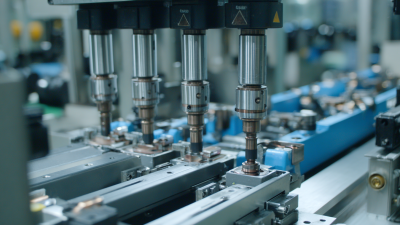
Picking the best autoinjector production line in China isn't just about comparing prices for equipment. Honestly, the right choice depends on a bunch of factors—like accuracy, validation support, how automated the system is, and how well it’s maintained over the long haul. A modern line should handle feeding, assembly, testing, labeling, and data recording smoothly and with consistent control. Plus, it’s really important that it protects delicate parts from scratches, contamination, or loading errors—nobody wants to deal with broken or compromised components.
Dr. Michael Chen, an independent expert in pharma manufacturing, often says, “A reliable line proves its worth through consistent quality, not just lightning-fast speeds.” That’s so true when you're actually running a factory. Operators need an interface that’s easy to understand, quick changeovers, and straightforward maintenance. Engineers, on the other hand, look for machines with controlled parameters, traceable production data, and trusted inspection systems. When shopping around, it helps to see these capabilities backed up by documented factory tests and realistic sample runs from the supplier.
Most top Chinese manufacturers tend to offer modular setups, which is pretty handy because they can adapt to different device sizes and volume needs. These systems often include features like vision inspection, leak testing, torque monitoring, and automated rejection systems. Still, no machine is perfect. Some suppliers throw around big numbers about speed without mentioning downtime, cleaning time, or how much effort validation actually takes. That’s definitely something worth digging into.
As a cautious buyer, it’s smart to review installation history, training plans, spare parts availability, and how quickly they respond to issues. Visiting a customer’s facility can really shed light on things details you won’t find in glossy brochures. Remember, the fastest or cheapest line isn’t always the best pick. The real deal is one that keeps producing consistent quality, provides solid documentation, and doesn’t break the bank over time. Even small flaws can turn into big problems down the road—that’s why it’s crucial to thoroughly test every technical promise before making that purchase.
The best autoinjector production line is not defined by speed alone. It combines controlled assembly, precise testing, traceability, and flexible changeovers. A typical line may include component feeding, spring insertion, needle-shield fitting, labeling, vision inspection, and functional testing. Each station should protect critical dimensions and reduce handling damage.
Grand View Research estimated a double-digit global autoinjector market CAGR of about 13.6% for 2024–2030. Fortune Business Insights also forecasts strong market expansion, with growth above 12% annually in its recent assessment. These figures increase pressure on manufacturers, but volume cannot replace process discipline. ISO 11608-1:2022 emphasizes performance requirements for needle-based injection systems, including dose delivery and user safety. Therefore, a reliable line needs calibrated force testing, injection-time measurement, leak detection, and documented electronic records.
A line producing 60 units per minute may still create costly rejects. Equipment qualification, preventive maintenance, and operator training matter equally. Real-time alarms should identify misfeeds, incomplete assemblies, and abnormal spring forces before release. I have seen efficiency figures look impressive until changeover losses were measured. That is a useful warning. The strongest Chinese production lines are usually those designed around validated processes, stable local support, and clear batch genealogy, rather than impressive machinery alone.
A reliable autoinjector line begins with controlled component preparation. Plastic housings, springs, needles, and seals require incoming inspection and clear batch records. Operators check dimensions, surface defects, and material certificates before assembly. Cleanroom controls help reduce particles during needle and drug-contact component handling. Automated feeders then position parts with consistent force and alignment. Some lines still need skilled operators for unusual component shapes. That balance is not perfect, but it prevents rigid automation from creating hidden errors.
Assembly follows with spring loading, cartridge placement, needle protection, and mechanical function checks. Vision systems inspect orientation and missing parts. Force testing confirms activation performance without damaging the device. Each unit should receive traceability data before final inspection. Packaging includes labeling, sealed pouches, cartons, and shipping protection. Packaging verification matters because a well-built device can still fail through poor sealing or unclear instructions.
Tips: Ask the manufacturer for process validation records, inspection plans, and sample batch data. Review line layout, operator training, and maintenance response times. Challenge the supplier about rejected components and recurring defects. A strong production line measures more than speed. It shows stable results across repeated trials. Be cautious when equipment demonstrations look flawless; real production usually reveals small variations. Linked quality controls, practical testing, and transparent records offer better evidence than impressive machinery alone.
The best autoinjector production line combines precision equipment with validated automation. Grand View Research estimated the global autoinjector market at about USD 2.3 billion in 2023. Its forecast also indicates steady growth through 2030. This trend raises pressure on Chinese manufacturers to improve output, traceability, and consistency.
A practical line starts with automated component feeding and nest handling. Servo-driven assembly stations can control spring insertion, needle-shield fitting, and housing closure. Machine vision checks orientation, gaps, surface defects, and missing parts. Force-displacement testing is valuable because a visual check cannot confirm internal performance. PLC control, SCADA monitoring, and MES integration help record every critical process value. Serialization and electronic batch records support reliable traceability. According to ISPE guidance on pharmaceutical manufacturing systems, data integrity must remain complete, accurate, and retrievable. That requirement is easy to underestimate.
Tips: Choose equipment with recipe control, quick-change tooling, and accessible cleaning areas. Ask for documented capability studies, not only attractive cycle-time figures. Factory acceptance testing should include rejected components and power interruptions. A line may run quickly during a demonstration. Real production is less perfect. Temperature changes, worn grippers, and inconsistent components can expose weak design choices. Plan preventive maintenance around actual failure data. Keep manual intervention visible, measurable, and limited.
What Is the Best Autoinjector Production Line in China?
The best autoinjector production line is not simply the fastest one. It is a controlled system that protects dose accuracy, sterility, device function, and patient safety. In China, manufacturers should align their quality systems with applicable NMPA requirements, GMP expectations, and ISO 13485 principles. Regulatory classification may differ between a medical device and a combination product. That difference matters.
Quality begins with incoming inspection. Operators should verify spring force, needle dimensions, container integrity, and material certificates. Automated vision systems can detect cracks, missing components, and incorrect assembly. Torque monitoring is also valuable. Small changes can affect activation force. Each batch needs clear electronic or paper traceability. Records should connect raw materials, equipment settings, operators, and test results.
Validation cannot be treated as paperwork. Installation, operational, and performance qualification should reflect actual production conditions. Functional testing may include activation force, injection time, dose delivery, leakage, and safety-lock performance. Calibrated equipment is essential. Environmental monitoring must match the product’s risk profile. A documented CAPA process helps investigate failures instead of hiding them.
No line is perfect. Human handling may still create variation. Software alarms can also be ignored when production pressure rises. This is where training, line clearance, and independent review become practical safeguards. Supplier audits, change control, and periodic revalidation strengthen long-term compliance. A reliable Chinese production partner should provide evidence, not promises: validated protocols, complete batch records, deviation reports, and audit-ready data.
This chart summarizes the main quality-control checkpoints for an autoinjector production line in China. A compliant line should combine incoming-material inspection, validated assembly, functional testing, packaging integrity checks, sterilization control where applicable, and complete batch traceability in accordance with the product’s approved NMPA requirements and applicable ISO standards.
China offers many autoinjector production lines, but the lowest quotation is rarely the best measure. Grand View Research estimated the global autoinjector market at about USD 2.3 billion in 2023. Demand is growing, so stable output matters more than impressive brochures. Compare actual cycle time, line availability, reject rates, and changeover hours. Ask for factory acceptance test records, not only presentation slides. A line producing 60 devices per minute may perform poorly if its vision system misses needle-shield defects.
The strongest comparison starts with quality control. Check whether the line supports 100% visual inspection, torque monitoring, force testing, and electronic batch records. ISO 11608-1 provides useful requirements for needle-based injection systems. Request recorded Cpk data for critical dimensions. A supplier should also explain software access, audit trails, calibration, and spare-part availability. In my experience, after-sales response can decide production continuity. A technically excellent line still becomes expensive when engineers wait weeks for support. This is where my judgment may be imperfect; performance depends heavily on product design and local validation practices.
Tips: Visit a running reference site. Watch operators change formats. Test reject handling with deliberately defective samples. Compare FAT and SAT protocols line by line. Review OEE data from several months, not one demonstration shift. Include cleanroom interfaces, training, cybersecurity, and preventive maintenance in the quotation. PMMI reports repeatedly show that packaging automation value depends on uptime, integration, and workforce readiness, not speed alone. A slower line with traceable controls may protect more value.
China’s best autoinjector production line is not the fastest one on paper. It is the line balancing validated capacity, flexibility, and total cost. Grand View Research estimated the global autoinjectors market at roughly US$2.5 billion in 2023. Its forecast also indicates double-digit growth through 2030. That demand favors scalable equipment, but unused capacity can quietly damage margins. Begin with a user requirements specification, not a supplier’s brochure.
Capacity should match realistic demand, including maintenance, rejects, and batch changeovers. IQVIA Institute’s Global Use of Medicines 2024 report projects global medicine spending could reach US$2.3 trillion by 2028. This supports expansion planning, not automatic overinvestment. A practical line should handle several device formats, adjustable assembly stations, automated vision inspection, and electronic batch records. Track OEE, changeover time, reject rate, and line-clearance duration. Small delays accumulate.
Cost evaluation must include tooling, validation, spare parts, training, energy, and software support. The lowest purchase price can become expensive after two years. ISO 13485 controls and ISO 11608 requirements should shape equipment design and verification. Factory and site acceptance testing should challenge sensors, torque controls, needle-shield placement, and device traceability. A faster line is not always better. I would leave expansion space, even when the forecast looks convincing. Forecasts are imperfect. That is precisely why modular capacity matters.
| Configuration | Typical Application | Nominal Capacity | Expected OEE | Format Flexibility | Changeover Time | Key Process Coverage | In-Line Inspection | Estimated Footprint | Estimated Investment in China | Typical Delivery Time | Best Fit | Overall Value Score |
|---|---|---|---|---|---|---|---|---|---|---|---|---|
| Entry-Level Semi-Automatic Line | Clinical batches, pilot production, and low-volume commercial supply | 20–40 units/min 1,200–2,400 units/hour |
65–75% | 1–2 device formats; manual recipe adjustment | 60–120 min | Component feeding, assembly, spring insertion, basic labeling, manual packing | Visual checks and sampling-based dimensional inspection | 60–100 m² | RMB 1.5–3.0 million | 5–8 months | Low initial demand and limited capital budget | 7.1/10 |
| Balanced Modular Automatic Line | Medium-to-high-volume production with several device variants | 60–100 units/min 3,600–6,000 units/hour |
75–85% | 2–4 formats; recipe-controlled changeover | 30–60 min | Automatic feeding, assembly, spring insertion, functional testing, labeling, serialization interface, and packing | Presence, orientation, dimensional, force, dose-release, and reject verification | 120–180 m² | RMB 4.0–7.0 million | 8–12 months | Most manufacturers seeking the best balance of capacity, flexibility, and cost | 9.0/10 |
| High-Speed Dedicated Line | Stable, high-volume production of one established device platform | 120–180 units/min 7,200–10,800 units/hour |
80–90% | 1–2 formats; limited mechanical conversion | 90–180 min | High-speed feeding, automated assembly, functional testing, labeling, cartoning, and pallet interface | Continuous vision inspection, force-displacement monitoring, leak or activation checks, and automatic rejection | 180–280 m² | RMB 8.0–14.0 million | 10–16 months | Large-volume demand with long production campaigns | 8.4/10 |
| Flexible Multi-Format Line | Contract manufacturing and portfolios with frequent product changes | 40–80 units/min 2,400–4,800 units/hour |
70–82% | 4–8 formats; tool-less or quick-lock change parts | 15–40 min | Modular feeding, assembly, functional testing, labeling, serialization interface, and configurable packaging | Recipe-based vision inspection, component presence, assembly position, force, activation, and label verification | 140–220 m² | RMB 6.0–10.0 million | 9–14 months | Frequent changeovers and multiple customer or product requirements | 8.7/10 |
| Integrated High-Containment Line | Pharmaceutical filling, final assembly, and packaging under controlled environmental conditions | 60–120 units/min 3,600–7,200 units/hour |
70–82% | 2–4 formats; validated recipe management | 45–90 min | Controlled transfer, filling interface, assembly, functional testing, labeling, serialization, and secondary packaging | Container closure, fill-volume interface, vision, force, activation, label, and data-integrity checks | 250–450 m² | RMB 12.0–22.0 million | 14–22 months | Regulated drug-device combination products requiring extensive validation | 8.2/10 |
It combines controlled component preparation, precise assembly, inspection, testing, and secure packaging. Speed alone misleads. Stable results matter more than impressive machinery.
Inspect plastic housings, springs, needles, seals, and drug-contact parts. Check dimensions, surface defects, material certificates, and batch records. Small defects matter.
Automated feeders position parts consistently. Servo stations control spring insertion, needle-shield fitting, and housing closure. Vision systems detect missing or misaligned components.
No. Skilled operators may handle unusual component shapes or unexpected variations. A practical line combines automation with measurable manual intervention. That balance is imperfect.
Functional testing may measure activation force, injection time, dose delivery, leakage, and safety-lock performance. Force testing reveals internal problems that cameras cannot see.
Traceability should connect materials, equipment settings, operators, inspection results, and test data. Serialization and electronic batch records make investigations faster and clearer.
Check labels, sealed pouches, cartons, instructions, and shipping protection. Inspect seal integrity and printed information before release. Packaging can still fail.
Manufacturers should align systems with applicable NMPA requirements, GMP expectations, and ISO 13485 principles. Product classification may affect regulatory responsibilities.
Request validation protocols, capability studies, inspection plans, sample batch data, deviation reports, and maintenance records. Ask about rejected components and recurring defects.
Test rejected parts, power interruptions, temperature changes, and worn tooling during acceptance testing. Demonstrations can look flawless. Real production usually reveals variation.
Choosing the best Autoinjector Production Line in China requires more than comparing equipment prices. A complete line should cover every stage, from component preparation, feeding, assembly, and needle or device integration to labeling, inspection, and final packaging. Modern automation technologies, including robotic handling, vision systems, precise dosing controls, and data tracking, can improve efficiency, consistency, and production safety while reducing manual errors.
The right solution must also support strict quality control and regulatory compliance through validated processes, clean manufacturing conditions, traceability, in-process testing, and reliable documentation. When comparing Chinese production lines, manufacturers should evaluate output capacity, product compatibility, changeover speed, automation level, maintenance requirements, expansion potential, and total operating cost. The best line is not necessarily the most expensive; it is the one that balances stable performance, flexible production, dependable quality, and long-term value according to the company’s product requirements and growth plans.